

When the Reel Meets Reality
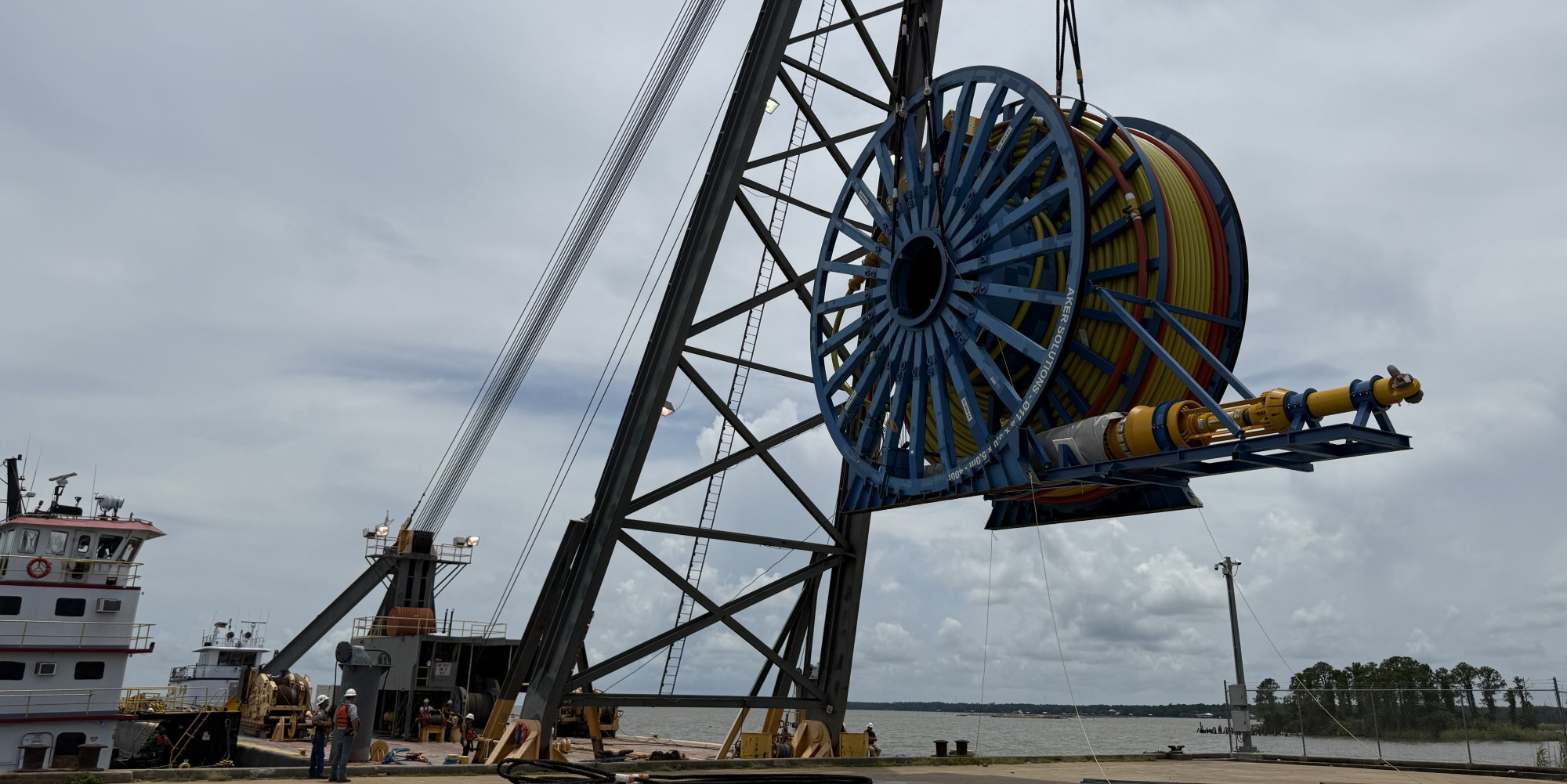
They say no two heavy-lift jobs are the same. And that’s true, especially when the cargo in question is a 400-tonne subsea cable reel sitting on a quayside at a port in the US Gulf, daring you to move it without making headlines. Reels like these are the lifeblood of offshore wind farms and undersea communication lines; yet, in a port environment, they appear less like high-tech infrastructure and more like stubborn, oversized spools of thread that happen to weigh more than an Airbus A380.
As a maritime consultant, I’ve seen my fair share of complicated lifts. Still, this one had all the ingredients of a classic: oversized cargo, unpredictable weather, nervous stevedores, and a team of professionals juggling rigging plans, crane schedules, and ballast calculations. Add to that a touch of southern heat, some gallows humour, and the occasional reminder that Murphy’s Law was probably a mariner in his past life, and you’ve got yourself a story.
Pre-Planning: Drawing Lines Before Lifting Giants
Every heavy-lift job begins in the conference room, not on the deck. At the port, we spread out rigging plans like generals over a war map. The reel’s specifications were precise: 400 tonnes, a high centre of gravity, fragile cargo (cables don’t like kinks), and an unforgiving steel frame.
We discussed rigging arrangements, lifting geometry, and crane coordination. One engineer insisted on triple-checking the shackle SWL (Safe Working Load), another argued about tag-line lengths, and someone in the back muttered, “Can we just use duct tape?” (humour, thankfully).
The lifting plan became our holy text: which crane would lift first, how the load would be transferred, who would call the signals, and, most importantly, what we would do if something went wrong. That’s the part most people skim over, but in our world, the “Plan B” is often what saves reputations.
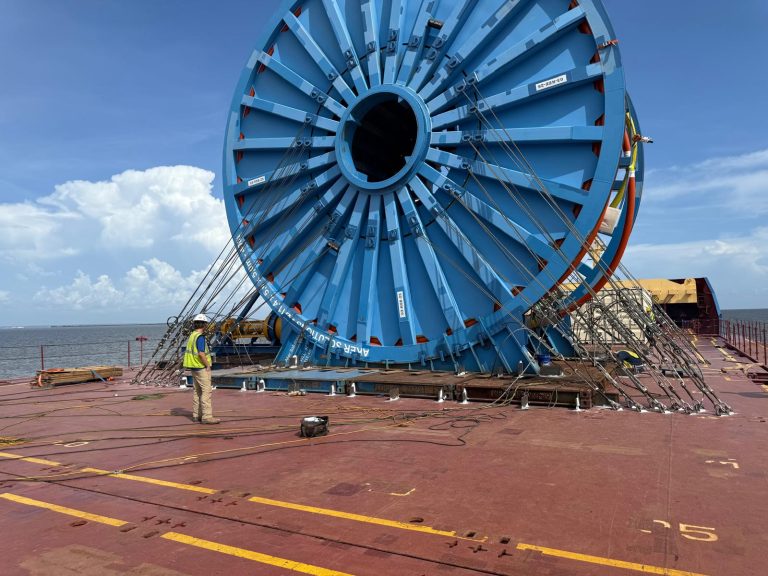
Finally came the securing plan. We all knew the reel wasn’t just about being lifted; it was about staying put during a Gulf of Mexico mood swing. Welded stoppers, chocks, turnbuckles, grillages-all of it meticulously designed so that the reel would remain as obedient as a well-trained Labrador, even if the ship rolled like a drunk sailor in heavy seas.
Risk Assessment:
Before we touched a single shackle, we conducted a structured risk assessment for loading the subsea cable reel. This began with identifying all potential hazards – ranging from crane overload and sling failure to reel instability, personnel exposure in the lifting zone, and even unexpected gusts of wind from the river. Each risk was analysed for likelihood and consequence using a standard risk matrix, and control measures were implemented accordingly. For example, to mitigate lifting risks, we specified certified rigging gear, redundant slings, and crane coordination protocols; to address reel movement on deck, we designed grillages capable of handling dynamic loads well beyond the static weight; and for human factors, we set up exclusion zones, assigned a single signaller, and rehearsed the lift communication sequence. The assessment was not just paperwork – it became a live reference document guiding every step, ensuring that technical safety, vessel stability, and crew well-being were integrated into one coherent plan.
The Lift: Ballet with Steel-Toed Boots
On the day of the lift, the port hummed with anticipation. Two cranes loomed like twin giraffes, ready to perform what we jokingly called a “pas de deux of doom.”
Lifting 400 tonnes isn’t about brute strength, it’s about choreography. Both cranes had to rise in perfect harmony, like a duet where one wrong move could turn a reel into a wrecking ball. The riggers tightened shackles, adjusted slings, and checked pins with the intensity of surgeons before an operation.
Then came the moment: the reel lifted slowly, its bulk straining against the laws of physics. For a second, it swayed, and a few of us imagined the newspaper headline: “Giant Spool Runs Amok”. But the cranes steadied, the taglines snapped taut, and the reel glided across the quay like an unwilling ballerina.
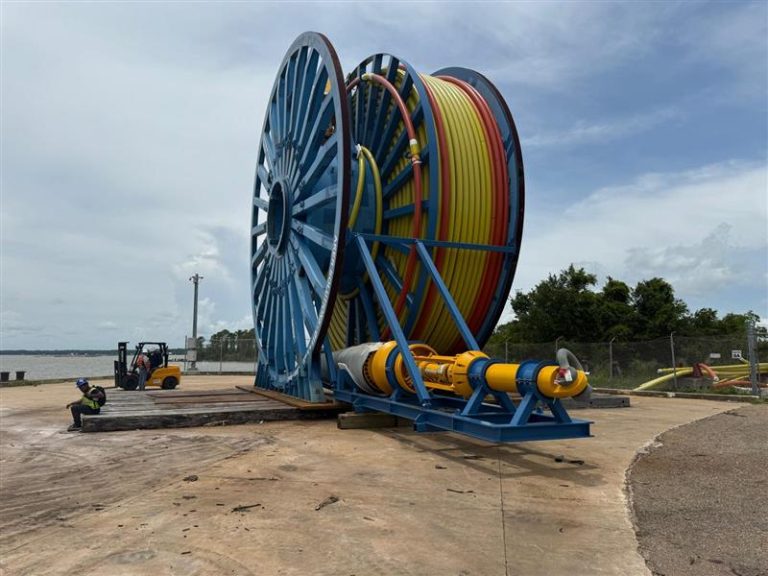
When it finally touched down on its grillage cradle, the collective sigh of relief was audible. Someone even clapped, though we quickly reminded him: “It’s not over until it’s secured.”
Securing: The Art of Not Letting Go
Our crew went at it with chains, turnbuckles, welded pads, and timber chocks. The reel looked less like cargo and more like a knight being armoured for battle.
In reality, our calculations told us otherwise. In rough seas, acceleration loads can double the forces acting on cargo. A 400T reel could effectively feel like 800T when the vessel pitches or rolls. That’s why redundancy matters. If one chain fails, another must already be in position. We doubled the lashings, welded extra stoppers, and ensured that if the reel ever decided to take a walk, it would run into a wall of steel and timber.
Sailing Out: The Gulf Doesn’t Care About Your Plans
With cargo secured, the vessel sailed into the Gulf of Mexico. That’s when nature reminded us that she had a say too. Weather forecasts had warned of rough patches, and sure enough, swells arrived to test both the ship and our engineering.
This is where multi-purpose Vessels (MPVs) earn their reputation. With adaptive ballast, a strong GM (metacentric height), and a hull built to take punishment, the ship rode the waves like a seasoned cowboy on a bucking bull. Still, accelerations mounted, and every creak of steel lashings sent shivers down our spines.
The crew monitored motions in real time, logging accelerations and adjusting ballast to reduce roll. The grillage performed exactly as designed, spreading loads across the deck and preventing tank-top distress. The reel? It sat stoically, as if mocking us for our excessive worry.
Do’s and Don’ts of Loading Cable Reels
Do’s
- Don’t over-engineer your grillage. If you think it needs six beams, use eight. Steel is cheaper than embarrassment.
- Do treat lifting plans as gospel. Improvisation has no place under a 400T hanging reel.
- Do communicate clearly. One wrong crane signal can turn “lift” into “disaster.”
- Do double your lashings. Redundancy is the only insurance against Murphy’s Law at sea.
- Do monitor the weather actively. The sea doesn’t care about your deadlines.
Don’ts
- Don’t rely on friction alone. Reels roll. That’s what they’re designed to do.
- Don’t ignore weld quality. A tack weld is not a sea fastening—it’s an accident in waiting.
- Don’t cut corners on ballast planning. Stability is the foundation of safety.
- Don’t let humour replace discipline. Jokes are fine, shortcuts are not.
- Don’t forget cargo sensitivity. Subsea cables cost millions; treat them like royalty.
Reflections: The Human Factor
At the end of the day, what makes or breaks a heavy-lift job isn’t just steel and engineering people. The riggers, crane operators, welders, and crew, turned what could’ve been a tense, nerve-wracking operation into a well-executed performance.
We laughed, we sweated, and we muttered a few choice words under our breath, but we never compromised on safety. That, I believe, is the balance: professionalism wrapped in humour. Because if you can’t smile while wrestling a 400-tonne reel into place, you’re in the wrong line of work.
And so, the reel reached its offshore destination, the ship returned safely, and at the port there was another story in its long history of handling the extraordinary to be told.
Closing Thought
Next time you see a subsea cable reel perched neatly on the deck of a ship, remember the invisible story: weeks of planning, hours of welding, minutes of heart-stopping crane choreography, and gallons of coffee. And perhaps, somewhere in the mix, a consultant muttering: “Well, at least it didn’t roll away.”
FMC International Editorial Team